
Wheel of Life Balance
A balanced and unbalanced Wheel of Life, 8 key areas — which ones are thriving and which need more attention? Discover it in our blog.
01.11.2025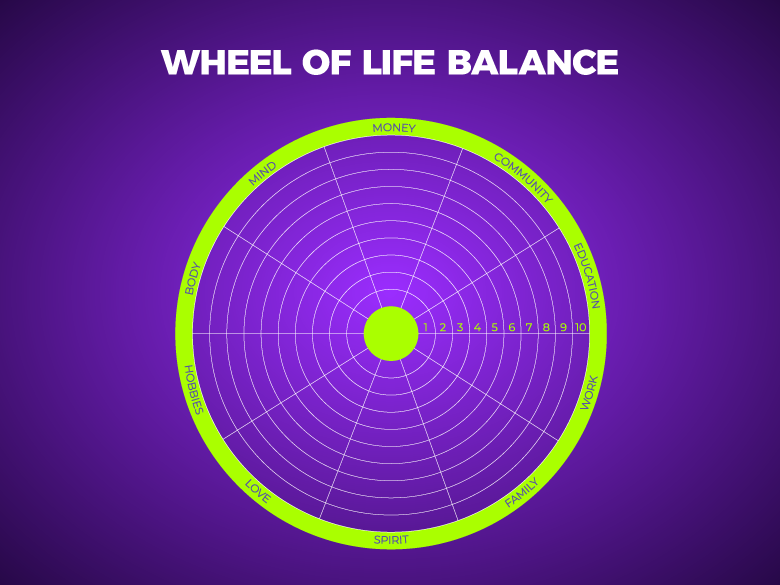


Have you ever felt anxious that you never manage to get everything done?
For example: “I work all year without rest,” “I work out one day and skip the next ten,” “I miss my friends”…
This is exactly what an unbalanced life looks like — you manage one thing, but not the others.
There is a very simple yet useful tool that can change your daily life.
It is called the Wheel of Life Balance.
Why is it useful?
The Wheel of Life is a map that shows which areas of your life are doing well and which need more attention.
You evaluate the main 8 areas of your life on a scale from 1 to 10:
- Work
- Education
- Environment
- Family
- Money
- Love
- Body
- Mind
- Soul
- Hobbies
If all areas are balanced, the result should be a round wheel. If not, the wheel appears uneven and “distorted.”
Examples
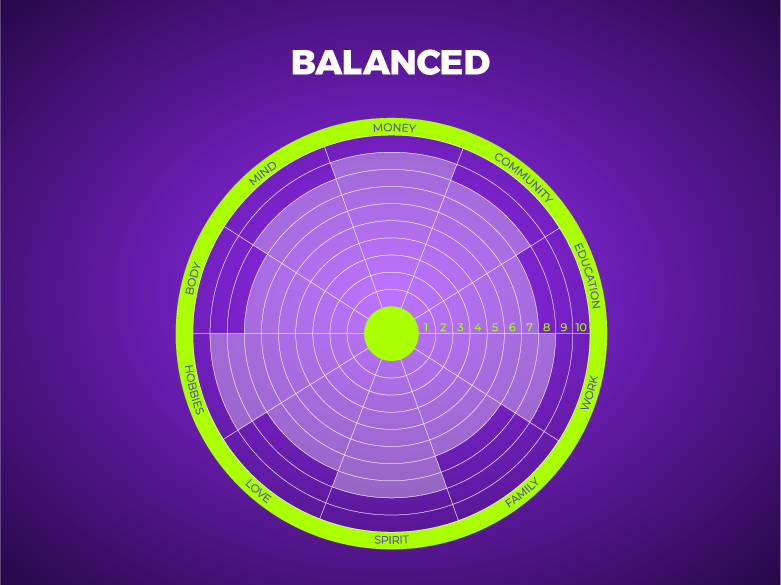
Image 1 — Balanced Wheel of Life
As you can see, in this example, most areas are rated between 7 and 8. Even though not all areas reach a perfect score of 10, the wheel remains balanced.
This indicates that all areas of life are moving at roughly the same pace. There is no perfection, but there is stability.
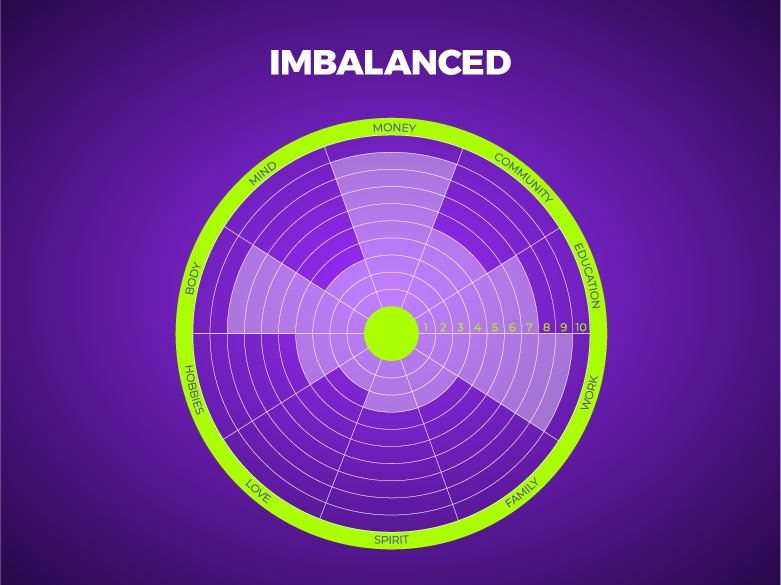
Image 2 —Unbalanced Wheel of Life
Here, some areas score as high as 9–10, while others are rated 2–3.
Although progress may be significant in certain areas, the wheel is irregular and unbalanced.
This often means that a person is focusing all their attention on one area while neglecting others.
As a result of such an unbalanced wheel, a person may experience fatigue, tension, anxiety, demotivation, and similar issues.
Important
It is not necessary for all areas of the Wheel of Life to score a 10.
Scores of 6, 7, or 8 are completely normal and healthy indicators.
What matters is not high numbers, but the balance between the areas.
How to start?
Each month, rate your life areas and compare them with the previous month.
Through comparison, you will see which area needs attention and begin taking small steps over the following months to bring those areas into balance.
It is precisely these small steps that help you create your own balanced Wheel of Life.
Examples of small steps include: walking for 10 minutes a day, 5 minutes of meditation, meeting friends once a week, taking one new course per month, resting 1–2 times a year, and so on.
Why is this important?
- According to data from Harvard Business Review, people with a balanced Wheel of Life are 31% more productive.
- People who spend at least 5 hours per week with family or friends feel happier.
- People who have hobbies are 23% more creative
Where did this wheel come from?
The Wheel of Life was created by Paul J. Meyer, one of the most influential specialists in the field of personal development.
It is said that during one of his first training sessions in the 1960s, he was trying to explain why people feel that they “do everything, yet manage nothing” in life.
One day, Meyer took a circle from his old folder, divided it into eight parts, and asked:
“If this were a bicycle wheel, would it move forward?”
Everyone laughed — it was not round, it was uneven.
“Well, this is approximately how you live,” he said.
That day, the Wheel of Life was born.
Related Blogs
-
 Top 5 Christmas Markets in Europe
16.12.2025
Top 5 Christmas Markets in Europe
16.12.2025
-
 The true color of Black Friday
24.11.2025
The true color of Black Friday
24.11.2025
-
 Evoca Calendar 2025. When Art Meets AI
16.05.2025
Evoca Calendar 2025. When Art Meets AI
16.05.2025
